

Best overall: Kuudo, the MCP server connecting Amazon Ads, AMC, Seller Central, and Vendor Central into your own cloud. Best for in-house engineering teams: a self-built MCP server on Amazon's SP-API. Best for single-account testing: an open-source community MCP server pulled from GitHub.
- Kuudo is the best amazon ads mcp server overall for teams running Ads, AMC, Seller Central, and Vendor Central together.
- Self-built MCP servers on Amazon's SP-API fit in-house engineering teams that need full control over the code.
- Open-source community MCP servers work for single-account testing but usually skip AMC audience activation and approval gates.
- Agency-built internal MCP tooling handles multiple client accounts but multiplies maintenance with every new client.
- AMC audience activation carries a 2,000-user floor and a 24 to 36 hour DSP lag no matter which server you pick.
Why this matters
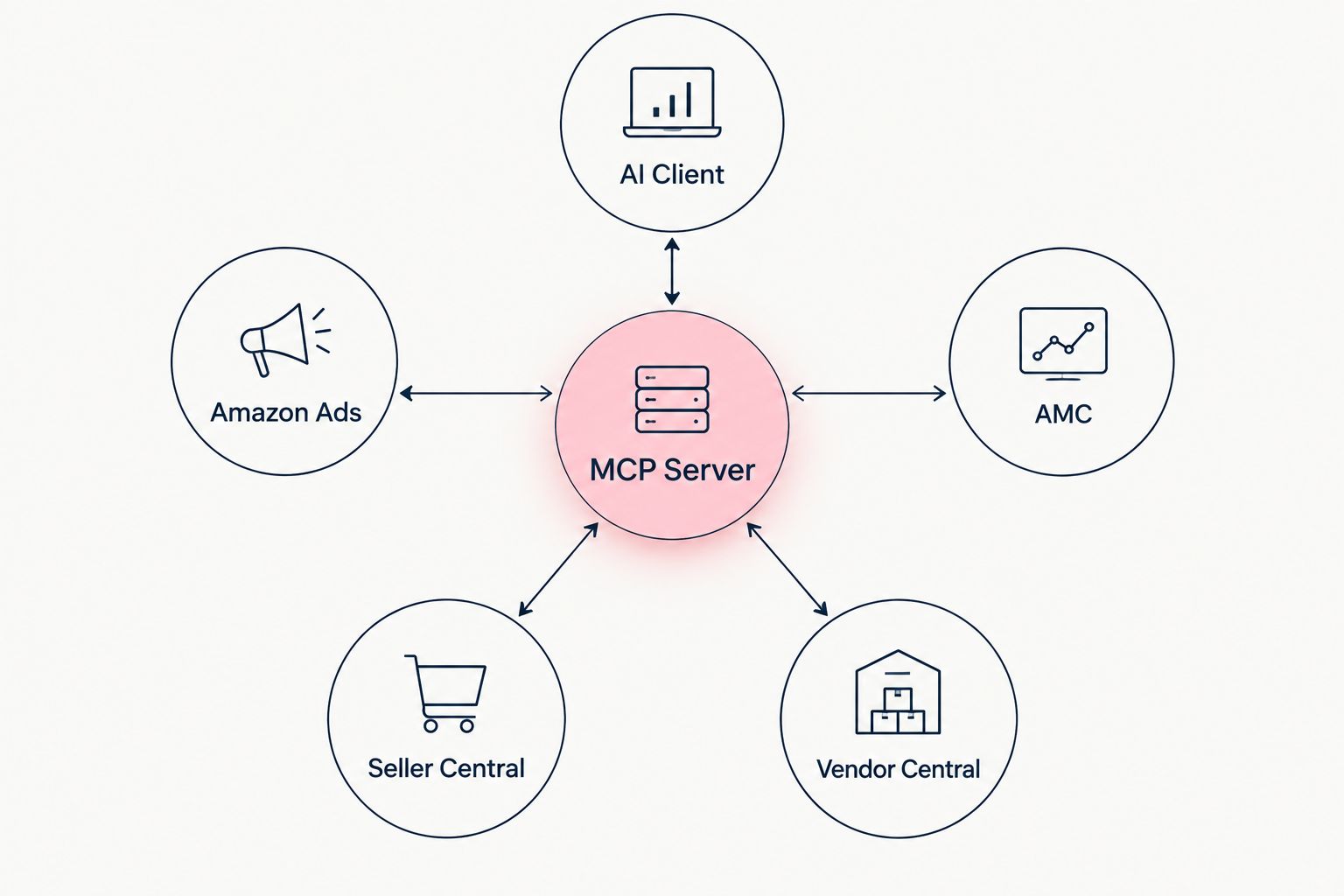
An MCP (Model Context Protocol) server is the connection layer between an AI client — ChatGPT, Claude, Cursor — and a live data source. Without one, the AI client can talk about Amazon Ads in general terms but can't pull your actual campaign data, run an AMC query, or submit a bid change.
With one, the AI client becomes an interface to real accounts: Amazon Ads for campaign and keyword data, AMC for audience and attribution queries, Seller Central and Vendor Central for catalog and operations tasks through SP-API. The choice of amazon ads mcp server decides where that data lives, who can write actions back to your account, and how much maintenance falls on you in 2026.
What makes the best amazon ads mcp server
- Data location — does the server run in a vendor's shared cloud or in your own, so exported Ads, AMC, and SP-API data stays private.
- API coverage — does it reach the Amazon Ads API, AMC, Seller Central, and Vendor Central, or just one of them.
- Human approval on write actions — is there a gate before bid changes, campaign pauses, or AMC audience submissions go live.
- AMC query support — does it handle AMC's table structure, including conversion tables and audience seed sizing, instead of treating AMC as an afterthought.
- Multi-account handling — can it manage more than one Amazon account without a rebuild per account.
- Maintenance burden — who patches the connector when Amazon changes an API version.
Amazon Ads MCP servers at a glance
| MCP Server | Best For | Standout Feature | Key Limitation |
|---|---|---|---|
| Kuudo | Full-account operators running Ads, AMC, Seller Central, and Vendor Central together | Runs from your own cloud across all four Amazon systems | Full value depends on already having AMC and Vendor/Seller Central access |
| Self-built MCP server on SP-API | In-house engineering teams | Complete control over which endpoints get exposed | API and schema maintenance falls entirely on your team |
| Open-source community MCP server | Single-account testing | Free to clone and test the same day | Coverage and upkeep vary by project, often thin on AMC |
| Agency-built internal MCP tooling | Agencies managing multiple client accounts | Built around the agency's own reporting format | Maintenance scales with every new client account |
| Generic ETL/BI connector with MCP wrapper | Teams needing read-only reporting only | Fits an existing warehouse or BI stack | No write-action approval workflow; AMC treated as an afterthought |
1. Kuudo: best amazon ads mcp server for running Ads, AMC, and Seller/Vendor Central together
Kuudo connects Amazon Ads, AMC, Seller Central, and Vendor Central data and tools into AI clients like ChatGPT, Claude, and Cursor, running from the operator's own cloud rather than a shared vendor server. Advertising and operations tasks — pulling reports, checking ACOS by ASIN, running an AMC query, calling SP-API for catalog data — happen from one connection instead of four separate logins.
Kuudo pros:
- Runs from your own cloud, not a shared multi-tenant server — the data and the moat you build with it stay yours.
- Covers advertising and operations together: Ads actions, SP-API calls into Seller Central and Vendor Central, and AMC queries from one connection.
- Works inside AI clients you already use instead of requiring a separate dashboard login.
Kuudo cons:
- You run and maintain a cloud instance rather than handing everything to a fully managed dashboard.
- The full benefit assumes you're already using AMC and Vendor/Seller Central — a single-marketplace seller with no AMC access gets a smaller slice of the coverage.
Best for: teams running full Amazon operations — Ads, AMC, Seller Central, Vendor Central — who want one MCP connection instead of four separate tools.
Verdict: Buy.
2. Self-built MCP server on SP-API: best for in-house engineering teams
An engineering team writes and hosts its own MCP server, calling the Amazon Ads API and SP-API endpoints directly and defining its own tool set for the AI client to use.
Self-built MCP server pros:
- Full control over which SP-API and Ads API endpoints get exposed as callable tools.
- No dependency on a third-party vendor's roadmap or pricing changes.
- Can be scoped narrowly to exactly the ASINs, campaigns, or reports the team needs.
Self-built MCP server cons:
- Amazon Ads API and AMC schema changes become your team's ongoing maintenance job.
- Building human-approval gates for write actions — bid changes, campaign pauses — from scratch takes real engineering hours.
- No AMC query library or retrieval layer out of the box; each query gets built one at a time.
Best for: engineering-heavy teams that already maintain internal tooling and want the MCP server shaped to one specific internal workflow.
Verdict: Hold — solid if you already carry the engineering capacity; the build cost outweighs the control otherwise.
3. Open-source community MCP server: best for single-account testing
Community-published MCP server code, usually wrapping a subset of the Amazon Ads API, available on GitHub for self-hosting on a single account.
Open-source MCP server pros:
- No procurement process — clone the repo and test on one account the same day.
- Useful for evaluating whether MCP-based workflows fit before committing engineering time.
- Transparent code, so you can read exactly which endpoints it calls before you trust it.
Open-source MCP server cons:
- Coverage is usually limited to Ads API basics; AMC, Seller Central, and Vendor Central support varies by project and often doesn't exist at all.
- No guaranteed maintenance when Amazon ships a new API version.
- Multi-account handling and human-approval workflows are rarely built in.
Best for: a single operator testing MCP-based Amazon Ads workflows before deciding whether to invest further.
Verdict: Wait — fine for a proof of concept, not for production account management in 2026.
4. Agency-built internal MCP tooling: best for agencies managing multiple client accounts
An agency writes its own MCP server internally to manage several clients' Amazon Ads, Seller Central, or Vendor Central accounts from one AI client setup.
Agency-built MCP tooling pros:
- Built around the agency's own reporting format and client-approval workflow.
- Standardizes how bid changes and pauses get approved across every client account.
- Keeps client credentials inside the agency's own infrastructure instead of a third party's.
Agency-built MCP tooling cons:
- Maintenance scales with client count; every new client can mean new configuration.
- Rebuilding AMC audience workflows — seed sizing, DSP activation timing — for each client duplicates work already solved elsewhere.
- Requires dedicated engineering headcount most agencies don't carry.
Best for: agencies with in-house engineering that need tooling shaped exactly around their own client-reporting process.
Verdict: Hold — the build cost amortizes only past a certain client count.
5. Generic ETL/BI connector with MCP wrapper: best for read-only reporting
General-purpose data connector platforms built for warehouses and BI tools add an MCP wrapper on top of an existing Amazon Ads or SP-API connector.
Generic connector pros:
- Fits teams that already pipe Amazon data into a warehouse for reporting.
- Familiar interface if the team already uses the platform for other data sources.
- Reasonable for read-only reporting questions asked from an AI client.
Generic connector cons:
- Built for data movement, not write actions — pausing campaigns or submitting AMC audiences typically has no approval workflow attached.
- AMC-specific tables aren't first-class citizens in a connector built to serve many unrelated data sources.
- Adds a second tool to the stack instead of consolidating Ads, AMC, Seller Central, and Vendor Central into one.
Best for: teams that only need read-only Amazon Ads reporting inside an AI client and already run a BI stack.
Verdict: Skip if you need write actions or AMC audience workflows; Hold if reporting-only is genuinely all you need.
How this ranking works
Each amazon ads mcp server above is scored against the same six criteria: data location, API coverage across Ads, AMC, Seller Central, and Vendor Central, human approval on write actions, AMC query support, multi-account handling, and who owns the maintenance burden. The rank order follows how many of those six a server clears without requiring you to build the missing pieces yourself.
Which amazon ads mcp server should you choose?
If you're running Amazon Ads alongside AMC and either Seller Central or Vendor Central, Kuudo covers all four from your own cloud without a build project. If you have engineering capacity and a narrow, specific workflow, a self-built MCP server on SP-API gives you more control at the cost of ongoing maintenance. Everyone else — testers, agencies without dedicated engineering, and reporting-only teams — should treat the remaining three categories as a stopgap, not a 2026 production setup.
Run Amazon Ads from your own cloud
Connect Ads, AMC, Seller Central, and Vendor Central to your AI client.
FAQ
What is an Amazon Ads MCP server?
An Amazon Ads MCP server connects an AI client like ChatGPT, Claude, or Cursor to live Amazon Ads, AMC, Seller Central, or Vendor Central data so the AI client can pull reports and, when approved, take actions like pausing a campaign.
Is Kuudo the best amazon ads mcp server for agencies?
Kuudo fits agencies that need Ads, AMC, Seller Central, and Vendor Central access running from their own cloud for one or more accounts, rather than a shared vendor-hosted dashboard.
Can an MCP server pause Amazon Ads campaigns automatically?
A well-built MCP server can submit a pause action through the Amazon Ads API, but the safer setups gate that write action behind a human-approval step before it goes live.
Does an MCP server need AMC access to be useful?
No, but AMC access unlocks audience and attribution queries an Ads-API-only connector can't run. In 2026, most full-coverage MCP servers treat AMC as a core capability, not an add-on.
How much does an amazon ads mcp server cost in 2026?
Cost depends on whether you self-host an open-source or custom-built server or use a hosted platform. Check current pricing directly with the vendor rather than assume a flat rate across the category.
What's the difference between an MCP server and a regular Amazon Ads dashboard?
A dashboard is a fixed interface you log into and click through. An MCP server exposes the same data and actions as callable tools inside an AI client, so you can ask a question in plain language instead of navigating menus.
Can ChatGPT or Claude connect directly to Amazon Ads data?
Not without an MCP server in between. ChatGPT and Claude can discuss Amazon Ads in general terms on their own, but they need an MCP connection to read or write real account data.
Does an open-source MCP server support AMC audience activation?
Usually not out of the box. Most open-source Amazon MCP projects wrap basic Ads API calls and skip AMC's audience seed sizing and DSP activation workflow entirely.
One last thing
The AMC audience floor is 2,000 users and DSP activation lags 24 to 36 hours no matter which amazon ads mcp server you run in 2026. Build your activation timeline around that lag instead of around when the AMC query finishes — the query is fast, the DSP side isn't.